 360
360Leadership 360 feedback assessment
other side of YOU?
LRN360 gives a leader honest feedback from the people around them, in plain language, with a clear path to act on what they hear.
The problem
See yourself clearly
The higher a leader climbs, the more the truth gets filtered before it reaches them. Their people stop bringing the hard stuff. The real feedback happens in the hallway, not to their face.
And the leader keeps leading on a picture of themselves that stopped being accurate years ago. The leader cares. No one has ever put the feedback in front of them in a way they could hear.
You can't fix what you can't see. It's time to see clearly.
What LRN360 does
A leadership 360 assessment built for action
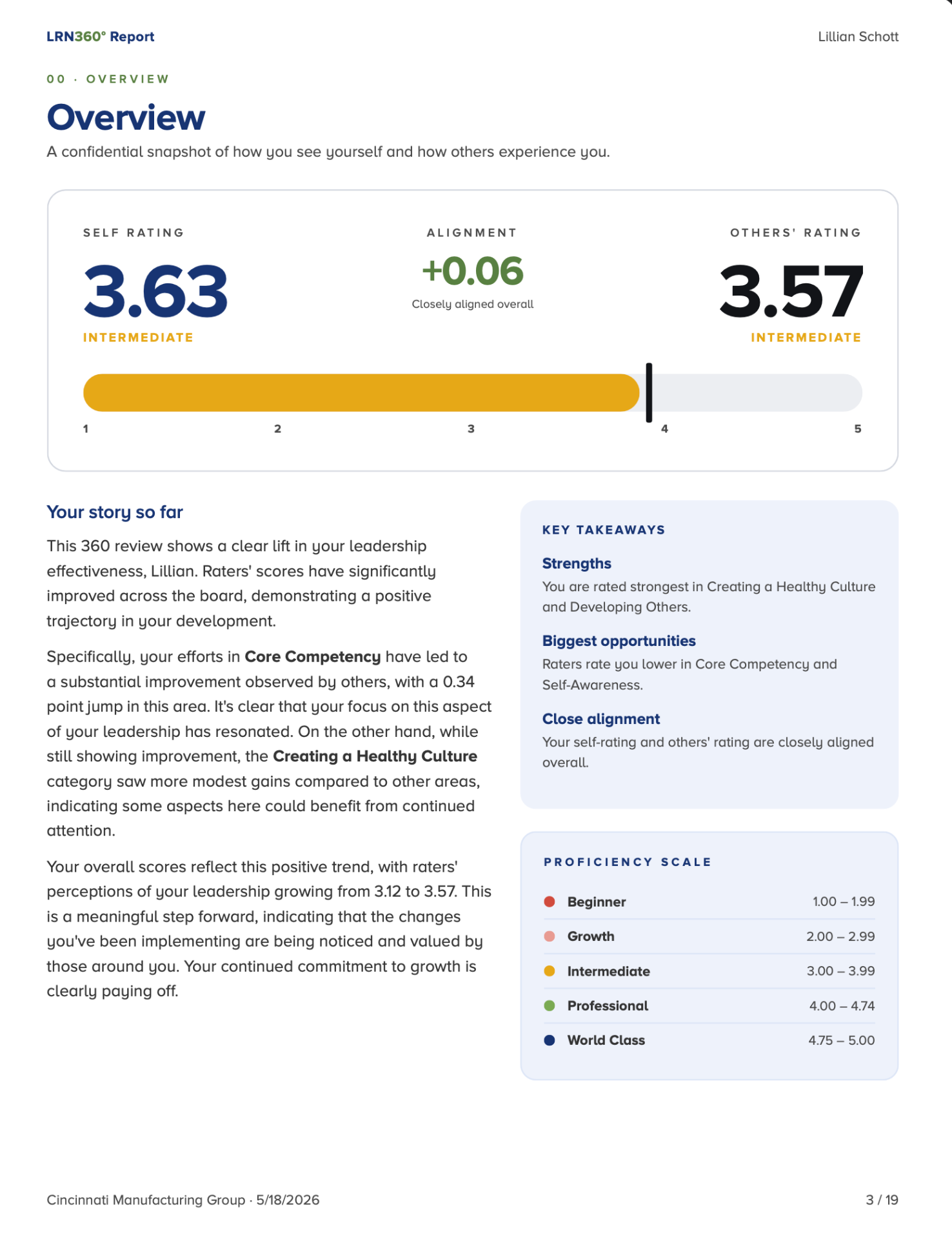
LRN360 gathers honest feedback on one leader from the people who work with them, then turns it into a conversation the leader can't have with themselves.
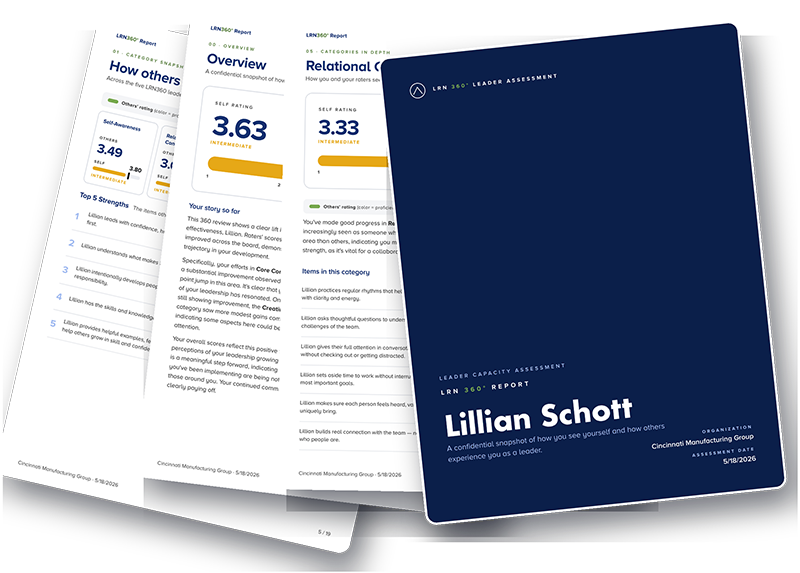
You get more than a score. You get a mirror with a map: see the gap between how the leader thinks they lead and how their people actually experience them. Then build your plan with specific changes to close the gap.
A number tells a leader where they rank. LRN360 tells them what to do on Monday.
How it works
Three steps. You name the leader. LRN does the rest.
Kickoff
A short setup call. You name the leader. LRN handles everything after that.
The feedback
Their people answer honestly and confidentially, in minutes.
The path
Depending on your tier, the results come back as a report, a live debrief, or a full development plan the leader keeps.
Who it is for
If you can picture the leader, you already know why this matters.
The leader who is too important to keep leading blind.
The high performer about to get promoted who has never been told what it is like to report to them.
The executive who asks for feedback and only ever hears the safe version.
Compare
LRN360 vs. a typical 360 assessment
Most 360 tools are built to measure. They hand a leader a number and consider the job done. LRN360 keeps the scoring, because the math matters, but it also does the part the others skip: it tells the leader what the number says about how they lead, and what to change.
| Most 360 tools | LRN360 | |
|---|---|---|
| What comes back | A score on a 1 to 5 scale across a list of competencies | The same scoring under the hood, explained as how the leader actually shows up |
| What a number means | A 3.8 and a percentile, left for you to figure out | "Here is what a 3.8 looks like on a Tuesday, and what it actually represents." |
| The language | Competency labels and statistical terms | Real sentences a person would say out loud |
| Who walks the leader through it | Usually no one, or a paid add-on | A live debrief with a guide who has done the climb |
| What you do next | Interpret it yourself | A written plan with two or three specific moves |
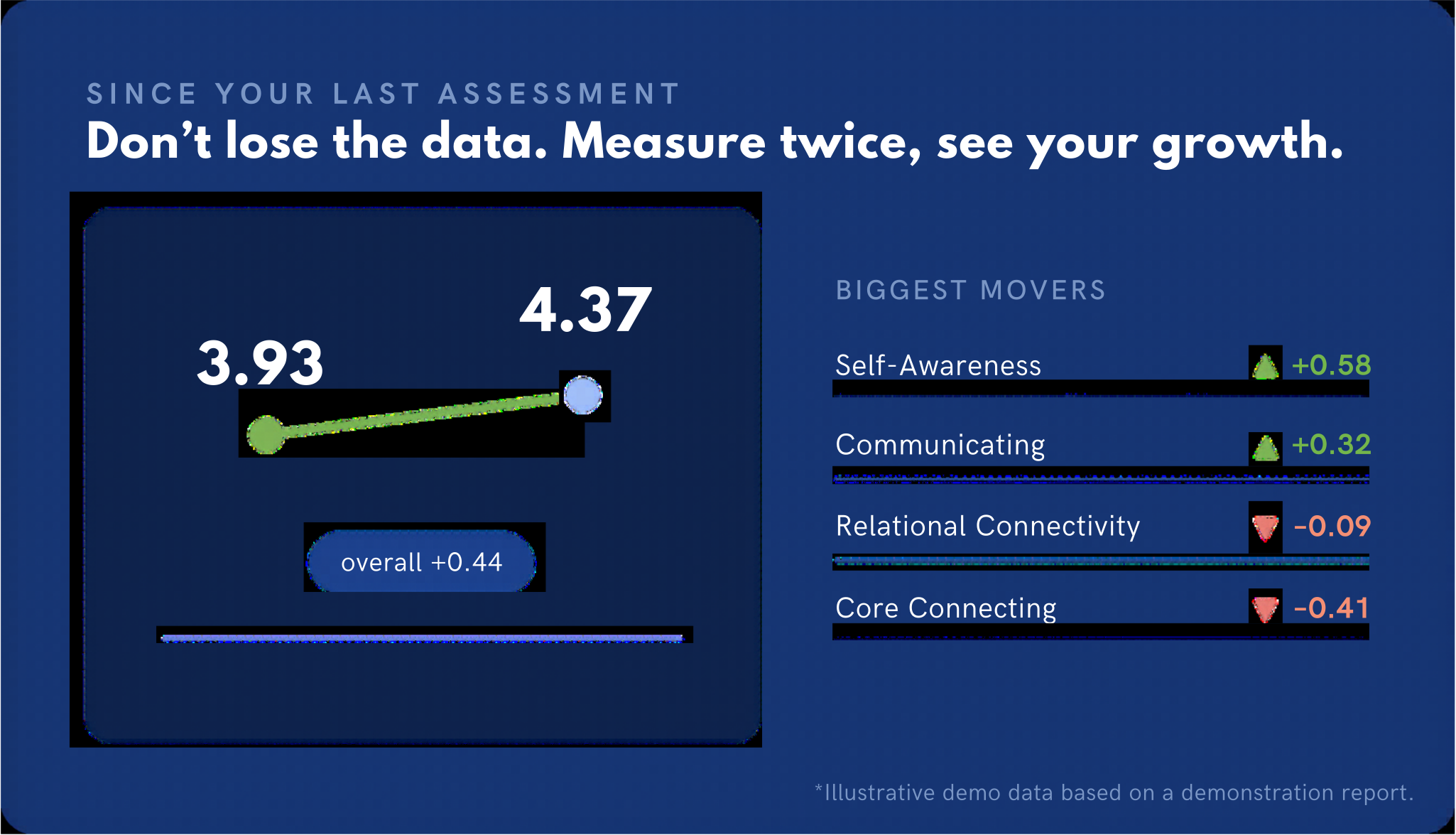
| Proof it worked | A one-time snapshot | An optional second assessment at nine months, side by side |
| The point | Measurement | Change |
Live debriefs, the written plan, and the second assessment come with the guided tiers.
The 3.8 explainer
What does a 3.8 mean?
A typical 360 leaves you guessing. LRN360 translates the number into action.
A typical 360 hands a leader a 3.8 out of 5 on "clear communication" and walks away. And what does the leader do about it on Monday?
A 3.8 might mean: their people trust their direction, but they've stopped bringing problems, because the leader solves them faster than they can finish the sentence. They're ready to own the solution.
That, a leader can picture. That, a leader can change.
Pricing
Three ways to start, depending on how far you want the leader to climb.
Every tier builds on the one before it, so you can begin where you are and move up without starting over.
Per leader. Volume pricing for three or more leaders from the same organization.
Mirror
See it.
The honest read, delivered clean. For the leader who is ready to look, and for the team that wants to test the work on one person before going further.
- Full LRN360 multi-rater assessment
- Confidential feedback from the people who actually work with the leader
- Written results report, plain language, no jargon
- Self-guided action prompts built into the report
- Email support through the assessment window
Mirror + Pathway
See it + change it.
The feedback is only half the work. This tier puts a guide in the room to turn the feedback into two or three changes the leader will actually make, and a plan they keep.
Everything in Mirror, plus
- Two live debrief sessions with an LRN guide
- A written development plan tied to the Growth Pathway
- A 30-day check-in to keep the changes from fading
- Priority scheduling
Full Climb
See it, change it, prove it.
For the leader, and the People director, who want to know it worked. A second full assessment at nine months shows what moved, in writing, side by side with where they started.
Everything in Mirror + Pathway, plus
- A second full LRN360 assessment at nine months
- A progress readout: what changed, what is next
- A before-and-after comparison the leader keeps
- First access when the full team version, Culture Signals, opens
Checkout opens soon. In the meantime, reach out to the LRN team to purchase or ask about volume pricing.
At a glance
Every rung of the climb, side by side.
| Feature | Mirror$350 | Mirror + Pathway$985 | Full Climb$1,265 |
|---|---|---|---|
| Price per leader | $350 | $985 | $1,265 |
| LRN360 multi-rater assessment | ✓ | ✓ | ✓ |
| Confidential written results report | ✓ | ✓ | ✓ |
| Self-guided action prompts | ✓ | ✓ | ✓ |
| Live debrief sessions | ✗ | 2 | 2 |
| Written development plan | ✗ | ✓ | ✓ |
| 30-day check-in | ✗ | ✓ | ✓ |
| Priority scheduling | ✗ | ✓ | ✓ |
| Second assessment at nine months | ✗ | ✗ | ✓ |
| Progress readout and comparison | ✗ | ✗ | ✓ |
| First access to Culture Signals | ✗ | ✗ | ✓ |
Three or more leaders from the same organization? Ask about volume pricing.
The bigger picture
One leader is the beginning. How is your team doing? There is the real question.
A 360 reads one person. Once a leader sees their own blind spots clearly, the next thing they ask is the one that matters most: what is it actually like on this team, for everyone?
That answer is coming. It does for a whole team what LRN360 does for one leader, surfacing what no one has named, then putting a price on it.
FAQ
The questions People
directors actually ask.
There is a leader on your team right now who is too important to keep leading blind.
The cheapest leadership development you will ever buy is one honest conversation they can't have with themselves.